When you search for an electrician near me, the instinct is to click the first result, scan for a phone number, and call. No credential check. No license verification. Just a hope that whoever shows up knows what they’re doing.
That reflex makes sense. Electrical problems feel urgent, and convenience wins. But the license type, insurance status, and whether you’re talking to the person who actually does the work matter more than the name at the top of a search result.
In Florida, a certified electrical contractor license isn’t a marketing badge. It’s a specific credential with legal weight, state accountability, and real consequences for the contractor who holds it. Knowing what that means, and how to verify it in about two minutes, changes how you hire. This article gives you the framework: how to recognize a real electrical problem, how to check credentials fast, what fair pricing looks like in 2026, and what emergency availability actually means in a rural county like Putnam.
When a local electrical problem actually needs a licensed electrician near me
Not every electrical issue requires an emergency call. But some do, and the difference is usually obvious if you know what to look for.
A breaker that trips once and stays reset is different from one that trips repeatedly under normal load. Repeated tripping means something in the circuit is drawing more current than it should. That’s a licensed electrician conversation, not a homeowner fix.
Flickering lights on multiple fixtures in the same room, a burning smell near an outlet or panel, or a buzzing sound from a switch are all signals to stop using that circuit immediately. These aren’t inconveniences. They’re early warnings.
Signs you should stop and call a pro right now
If you smell something burning, see discoloration around an outlet, hear buzzing from a panel or switch, or a breaker won’t stay reset, don’t troubleshoot it yourself. Turn off the affected circuit at the panel if you can identify it safely. Don’t plug anything else into that circuit until a licensed electrician has looked at it.
If there’s visible heat, smoke, or any active burning, leave the room and call emergency services first. An electrician comes second.
What you can safely do before the electrician gets there
Identifying and switching off the correct circuit breaker is genuinely helpful and safe for most homeowners. Beyond that, the list gets short. Opening the panel box, touching wiring, or using a non-contact voltage tester without understanding what a live reading means are the things to leave alone. The goal before a licensed electrician arrives is to stop the problem from getting worse, not to solve it.
The electrical issues that quietly compound without a real repair
Some problems feel minor but escalate fast. A loose neutral wire causes voltage fluctuations that damage appliances over time and increase fire risk well beyond the original point of failure. A panel that’s been patched by an unlicensed person with mismatched breakers becomes a code violation and an insurance liability, often without the homeowner knowing until they try to sell the property or file a claim.
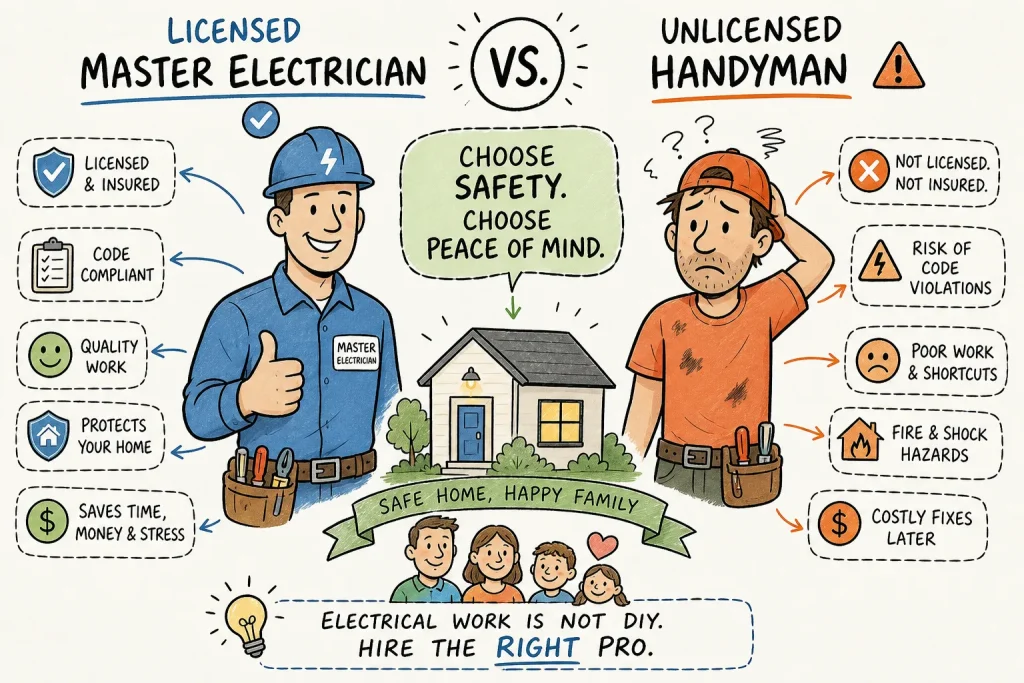
What actually separates a Florida certified electrician from an unlicensed handyman
The difference isn’t experience alone. It’s legal accountability.
A Florida certified electrical contractor license requires passing a state exam, carrying liability insurance, and operating under the oversight of the Florida Department of Business and Professional Regulation. The contractor can pull permits, take legal responsibility for their work, and be held to a documented standard. An unlicensed person has none of that paper trail.
What a Florida certified electrical contractor license actually authorizes
Florida’s certified electrical contractor (EC) license, the credential issued and regulated by the DBPR, allows the holder to contract for residential and commercial electrical work anywhere in the state, pull permits, and take full legal responsibility for the installation. It’s not the same as a journeyman credential, which only authorizes work under a licensed contractor, and it has nothing to do with a handyman operating outside any licensing framework entirely. You can verify any contractor’s classification, status, and disciplinary history through MyFloridaLicense.com.
Jamie Murrow Electric holds a Florida electrical contractor license verifiable through the DBPR’s online system. That license number is the kind of detail a real licensed contractor volunteers without being asked, search by the business name at MyFloridaLicense.com to confirm status and classification before booking.
What you lose when you hire without verifying credentials
No license means no permit, which means no inspection. Without a third-party inspection, no one outside the contractor has confirmed the work is safe. If a fire starts from faulty wiring installed by an unlicensed person, your homeowner’s insurance claim may be denied or contested, policy responses vary, so check your terms and consult your insurer directly.
You also lose legal recourse. While you can report unlicensed activity to the DBPR, your local building department, or the state attorney general’s office, filing a formal complaint with a licensing board requires that the contractor actually hold a license. Bonding and workers’ compensation coverage, which protect you if a worker is injured on your property, disappear from the picture as well.
The handyman gray area in Florida
Some homeowners hire a handyman for electrical work because the upfront cost is lower. The problem isn’t always incompetence. It’s accountability and code compliance. Work done without a permit doesn’t appear in your home’s records, and that creates problems when you sell, when you file an insurance claim, or when the next licensed electrician discovers what was done and has to walk you through it.
How to verify an electrician near me before you book a visit
This takes less time than most people expect. The Florida DBPR has an online license lookup at MyFloridaLicense.com. Search by the contractor’s name, business name, or license number. Look at three things: license status (active), license classification (electrical contractor, not just registered), and any disciplinary history. A licensed contractor should give you their license number without hesitation. If they pause, that’s information worth noting.
How to look up a Florida electrical contractor license in under two minutes
Go to MyFloridaLicense.com and select “Verify a License.” Enter the contractor’s name or license number, then review the result. Confirm the name and business name match what’s on their proposal or vehicle. Check that the license type covers electrical contracting work, that the status shows as active, and that there’s no disciplinary or enforcement history attached to the record. Save or screenshot the page before signing anything.
Insurance and workers’ compensation: what to actually ask for
Request a current certificate of general liability insurance before anyone comes to your property. A reasonable benchmark for residential work is $500,000 to $1 million in coverage. If the contractor has employees, ask for proof of workers’ compensation as well. Without it, an injury on your property could become your financial problem. Ask them to send the certificate by email or text before the visit; a legitimate contractor keeps that document ready to share.
Questions worth asking on the first call
Ask who will actually perform the work: the owner or a subcontractor. Ask whether the job requires a permit and who pulls it. Ask how they approach diagnosis before quoting a price. A contractor who answers these plainly, without hedging or pressure, is showing you how they operate. If they push for a same-day commitment before seeing the problem, that’s your answer too.
What electrical work typically costs near East Palatka in 2026
Licensed electricians in the rural Southeast typically charge $75 to $130 per hour for residential work, with a service call or diagnostic fee commonly running $75 to $200. These numbers apply to licensed work with proper materials and permits included, not a handyman doing the job off the books.
Common flat rates for residential electrical work
Current flat rates for common residential jobs include breaker replacement at $100 to $250, outlet installation at $100 to $350, and panel upgrades at $1,300 to $4,000. These ranges are a reasonable baseline for comparing quotes, not guarantees for any specific job. Variables like access difficulty, permit fees, and specialty materials will shift the final number, and a legitimate contractor will explain those variables in writing.
Generator installation and mobile home electrical: what to budget
Generator installation is a specialty service with real cost variables. Whole-house standby systems in Florida typically range from $8,000 to $20,000 installed by a licensed contractor, depending on generator size, transfer switch type, and site conditions. Smaller essential-circuit setups or portable-generator hookups can run considerably less, generally in the $500 to $5,000 range depending on scope. Mobile home electrical service carries different but comparably specialized costs due to the dedicated wiring systems, exterior disconnects, and permit requirements involved, commonly in the $2,000 to $6,000 range, though site-specific factors can push that higher. Get those numbers clarified in a written estimate before any work begins. The permit and inspection requirements alone put both job types outside the territory of an unlicensed quote.
How to spot a quote that’s hiding something
A legitimate estimate separates labor, materials, permit fees, and exclusions. A vague lump sum with no line items is a red flag. Unusually low bids often skip permits, use substandard materials, or leave the scope undefined so extras can be added later. Get at least two written estimates and compare what each one actually covers, not just the bottom-line number.
Emergency electrician near me: what “local” really means in Putnam County
Reputable local electricians typically arrive within 30 minutes to 2 hours for genuine emergencies under normal conditions. In a rural area like Putnam County, that window depends entirely on how close the contractor actually is. A company headquartered in Jacksonville advertising “local service” may have an hour-plus dispatch time before anyone gets on the road. A licensed electrician physically based within the region is a genuinely different situation.
Response times in a rural area: realistic expectations
When you call, ask for the estimated arrival window and confirm that a licensed electrician is physically on call, not just a voicemail service with a next-morning callback policy. Severe weather, high call volume, and road conditions can push arrival times beyond two hours even for serious providers. Knowing that ahead of time helps you make smarter decisions about what to do while you wait.
After-hours rates and what to confirm before you say “come out now”
Emergency and after-hours service commonly runs $150 to $250 per hour, sometimes with a minimum call-out fee on top. Before authorizing a same-night dispatch for a non-urgent problem, confirm the after-hours rate and the minimum charge. Also confirm that a licensed electrician, not a trainee, is being sent. For genuine emergencies involving smoke, heat, exposed wiring, or a burning smell from a panel, act immediately regardless of cost. For everything else, knowing the premium helps you decide whether it’s worth waiting until morning.
Why Putnam County homeowners call Jamie Murrow Electric first
Jamie Murrow Electric is built around one straightforward principle: the person who answers the phone is the person who shows up and does the work. No dispatcher, no call center, no relay of information through layers of staff. You talk to the owner directly, a Florida-licensed electrical contractor serving this community with hands-on experience and a one-person operation model that keeps diagnosis honest.
That directness changes the quality of the diagnosis. When the person who picks up your call is the same person assessing your panel and running the repair, you get honest information without inflated scope or unnecessary upsells.
What direct owner communication actually looks like
Most electrical companies route calls through a dispatcher who relays information to a technician who then quotes the job. That chain introduces errors, pressure, and misaligned incentives at every link. At Jamie Murrow Electric, the diagnosis comes from the licensed electrician handling the job, and the explanation comes directly to you. That’s simply how a one-person operation with professional standards runs.
Mobile service across East Palatka, Palatka, and surrounding communities
Jamie Murrow Electric serves residential and commercial customers within approximately 45 miles of East Palatka, covering Putnam County and the surrounding area. There’s no shop overhead passed along to the customer.
The Florida electrical contractor license is verifiable through the DBPR in under two minutes at MyFloridaLicense.com, search by business name and confirm the status is active before booking. Generator and mobile home electrical work is priced based on a site assessment, since scope, permit requirements, and materials vary significantly. Reach out directly to schedule an on-site assessment and get a straight answer about what your job actually involves.
The short version of everything above
Verify before you book. Any licensed electrician near me, or anywhere in Florida, should give you their license number, carry liability insurance, and pull the required permits. Those three things aren’t bureaucratic overhead. They’re the basic framework that protects you when something goes wrong.
A quick search on the DBPR website tells you whether the contractor you’re considering is licensed, active, and in good standing. That search takes two minutes. The consequences of skipping it can take years to sort out, especially when they show up at closing, in an insurance claim, or inside a wall.
If you’re searching for a reliable electrician near me in East Palatka, Palatka, or anywhere in Putnam County, for repairs, panel work, generator installation, or mobile home electrical service, Jamie Murrow Electric is worth that first call.